Niall Farrell, DCU Institute of Education and DCU Anti-Bullying Centre
Research Overview:
This research explores how LGBTQ+ teachers experience and navigate heteronormativity Irish within post-primary schools. Heteronormativity is the assumption that heterosexuality is the norm and default sexual orientation of individuals. It aims to understand how LGBTQ+ teachers experience heteronormativity in their schools, including how they manage their professional identities, how school culture can impact pedagogical practice and how these experiences impact wellbeing and career progression.
Looking for:
If you are an LGBTQ+ teacher working in a post-primary school in Ireland, you are warmly invited to take part in either a focus group (45–50 minutes) or an individual interview (45–60 minutes). You’ll be invited to share your experiences and reflections in a confidential, supportive setting. Participation is fully voluntary, and confidentiality will be ensured. Sessions can take place at any date and time that suits you, and arrangements will work around your personal schedules. This study has received full ethical approval from the DCU Research Ethics Committee.
For more information or to express interest, please contact:
� lgbtqdcuresearch@gmail.com
We are conducting a study exploring the life experiences of LGBTIQ+ adults aged 50 and above in Ireland and Türkiye. The research focuses on social inclusion, community belonging, access to services, and lived experiences over time. Participation involves a confidential one-to-one interview (45–60 minutes), either in person (at a safe, agreed venue) or online.
Participation is voluntary, and all data will be anonymised. You may withdraw up to five weeks after the interview (before anonymisation).
We are particularly interested in hearing diverse experiences across the LGBTIQ+ community.
If you are aged 50 or above and would like to take part, please contact:
Dr. Sinan Aşçı
sinan.asci@dcu.ie
Have you experienced online dating, online romantic communication, or online romantic rejection?
Would you like to help shape PhD research in psychology at Liverpool John Moores University?
Ali Carey is looking for people to join a Patient and Public Involvement (PPI) group for research exploring online romantic rejection, including ghosting, blocking, breadcrumbing, hostile rejection, and identity-based rejection, and how these experiences may affect wellbeing. Ali would especially like to hear from transgender, non-binary, and gender-diverse people, as well as people with experience of online dating platforms or online romantic rejection. No research experience is needed.
PPI means helping to shape the research, rather than taking part as a research participant. You may be invited to attend occasional online meetings, review survey questions or documents by email, comment on wording and inclusive language, identify missing perspectives, and give feedback on study materials and recommendations.
This PhD project explores different forms of online dating rejection, their effects on mood, self-esteem, loneliness, and wellbeing, whether experiences differ for cisgender and transgender/gender-diverse people, and how support could be improved. It also includes
development of the Online Romantic Rejection Distress Scale (ORRDS).
To express interest, contact Ali Carey at A.J.Carey@2025.ljmu.ac.uk.
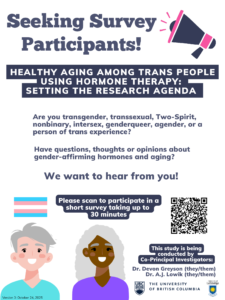
It’s great news that growing numbers of trans people using gender-affirming hormone therapy are growing old! However, we don’t have much research evidence on healthy trans aging yet. Trans people anywhere in the world can help us understand priorities w this anonymous survey! tinyurl.com/5w3sptxn
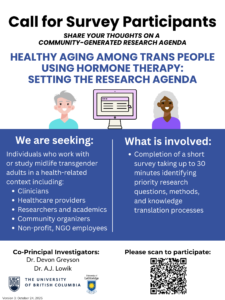
HEALTHCARE PROVIDERS and HEALTH RESEARCHERS can help set priorities w this survey! tinyurl.com/5w3sptxn
This project explores how online mis- and disinformation affects LGBTIQ+ young people in Ireland, including those from minority identities.
The study aims to:
- Explore the impact of social media misinformation and disinformation on LGBTIQ+ young people;
- Examine the strategies and tools employed by LGBTIQ+ young people to navigate this environment;
- Provide guidance on how they can be better supported to mitigate the harmful impact of mis-and disinformation online.
What does the study involve?
Participation in the study is voluntary and offers two degrees of involvement. Participants are not required to be involved in all areas of research.
- Interviews (~30 minutes) with LGBTIQ+ young people (aged 18-24 years old) to discuss their experiences of online mis- and disinformation, both before and after the diary exercise;
- Diary exercise (10-14 days, 5-10 minutes each day)
For those interested in further participation, participants can partake in a diary exercise where they will record the information and content they witness via their online platforms, including details of any mis-and disinformation they encounter.
Participation in this project is conducted online and includes a voucher [ of at least €75 ] upon completion of all parts of the study.
Questions? Please contact paul.reilly@glasgow.ac.uk for more information.
Have Your Say
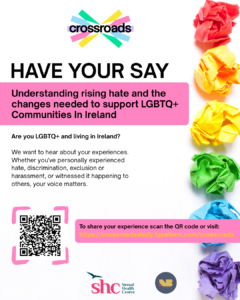
Many LGBTQ+ people are telling us that something has changed in recent years. Alongside important progress, there are increasing reports of hate, hostility, discrimination, misinformation and disinformation. This independent national research study aims to better understand these experiences and identify what needs to change to strengthen therights, safety, wellbeing and participation of LGBTQ+ people in Ireland, with a particular focus on trans and gender-diverse people.
The Sexual Health Centre, in partnership with Dr Michael Barron and Jaime Nanci of NB Social Justice Studio, is undertaking this research with funding from the Irish Human Rights and Equality Commission (IHREC).
We are inviting LGBTQ+ adults (18 years and over) living in the Republic of Ireland to complete an anonymous online survey, which takes approximately 15 minutes. A smaller number of participants will also be invited to take part in confidential interviews or focus groups.
Participation is entirely voluntary and anonymous, and you may skip questions or stop at any time.
We particularly encourage trans and gender-diverse people to take part.
Recruitment: July–September 2026.
For further information, accessibility requirements or interview participation, please contact:
Dr Michael Barron
michael@nbsocialjustice.studio
Sexual Health Centre
fiona@sexualhealthcentre.com | +353 (0)21 427 6676
Tilting the Lens has been commissioned by Coimisiún na Meán, Ireland’s media regulator, to lead an important new research project examining the quality of subtitling and Irish Sign Language (ISL) provision across television, broadcasting, and Video On Demand services in Ireland. The project is being delivered in partnership with the Centre for Deaf Studies at Trinity College Dublin and Sofiya Kalinova (Project Manager).
At the heart of this work is a simple principle: decisions affecting Deaf and Disabled people should be informed by Deaf and Disabled people and always through an intersectional lens. We want to ensure that Deaf people’s experiences, perspectives and expertise help shape this project from the very beginning. This is why we are inviting expressions of
interest from Deaf, DeafBlind and Hard-of-Hearing people who would like to participate in any of our upcoming research projects.
You can register your interest here.
Over the next few months, we will be undertaking workshops, focus groups and a large-scale survey. All participation will be paid and accessible. We will contact you as opportunities arise!
Paid survey: now taking applications This survey has been co-designed with Deaf advisory members to ensure a meaningful approach and accessibility. We are seeking for Deaf, DeafBlind and Hard-of-hearing participants living in Ireland from a range of backgrounds, identities, experiences, and perspectives. If you would like to be considered, please register by Tuesday 25th of August.
Survey Registration Information:
- Format: online accessible survey
- Hosting platform: Accessible Surveys
- Flexible response formats: written text or Irish Sign Language (ISL) video submission
- Dates: open from 20th August to 4th September
- Duration: approximately 40 minutes
- Payment: €70 for participation
No previous research experience required The survey will be hosted on Accessible Surveys and is available in English, ISL, Easy Read and Read Aloud formats. This platform is WCAG Level AA compliant. Responses will be collected via written or ISL video.
If you have any accessibility concerns, please email us at accessibility@tiltingthelens.com.